|
Fashions exist in art
and in ideas quite as much as in women's clothes and in
the world of the mind they are much more dangerous, for
instead of being put forward frankly as fashions they are
presented as the new truth.
How refreshing then, how salutary, how encouraging, to
find a man who is prepared laboriously to think things out
for himself, who will work alone for years to develop his
own vision, his own technique, and who will not allow
himself to be deflected from his chosen path by so-called
experts speaking an esoteric language directed only at
in-groups and which, as Anna Russell puts it "leave the
average person as befogged as before.''
In photography, as in so many other fields, it is the
loners who break the trail, who make the path that others
can follow. They are few; yet their originality is seen
later to have led them straight into the mainstream whilst
the work of others, sometimes more immediately successful,
is relegated to a mere expression of the fashion of the
times.
John Cohen is very definitely a loner. If he had not been,
he could never have produced the charming, sentimental,
yet so very personal photographs in this book. For in an
age of tension and violence, when all of us are
continually bombarded by images of horror, to make
photographs, solely for pleasure, and expressing the
gentler aspects of life, is to court the accusation of
being escapist, of deliberately ignoring the allegedly
sole business of the photographer, which is said to be
realism and reportage, to be a mirror of the times.
In all his work John Cohen emphatically refuses to be tied
down by such notions. He insists on being himself, and in
so doing he strikes a blow for the freedom of the
individual, and for the freedom of photography. With every
photograph he says: "there is more to life than dustbins
and death, than weariness and war; even in an overcrowded
world there is room, and a need, for sweetness and
light.''
Light! That narrow band in the energy spectrum, without
which all life on earth would perish! As
Lord Kenneth Clark reminds us "From Dante to Goethe, all
the greatest exponents of civilisation have been obsessed
with light." This obsession is no stranger to
photographers.
Indeed, since the photographic image is made by the action
of light, truth to light is truth to the medium of
photography!
All John Cohen's photographs are made, simply and solely,
by the use of light. His magic is the magic of
the luminous, his poetry is that of the chiaroscuro.
The attractions of his work is all the greater for the
purity of the photographic technique, and its appeal all
the more universal for being couched in an imagery common
to all men and intelligible to all.
From early beginnings in 1963, John Cohen's work soon
attracted attention. An article in the magazine
'Photography' in 1964, acceptance in the London Salon of
Photography in 1965, the principal trophy there in 1967:
all were encouraging signs. But it was his one-man show at
the 'Wall of Colour,' Kodak which set the seal of success
and of future development on his work; for this was the
first such exhibition which Kodak had given to an amateur.
It led to exhibitions in the Edinburgh Festival 1968, in
the Coliseum and in Grand Central Station, New York, in
the National Film Theatre, London, and in many worthwhile
venues in the provinces.
But this portfolio is more, much more, than a one-man
show, fascinating though this aspect is in itself. It is
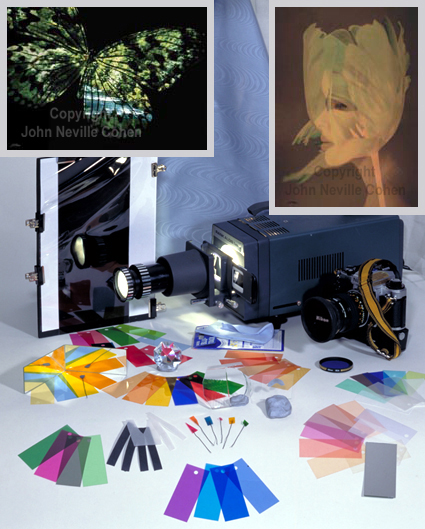
also a 'how-to-do-it' presentation. And this part is
immensely useful to all who feel inclined to use their
camera imaginatively. For it turns out that far from
needing elaborate and expensive apparatus to produce his
delightful and mysterious results, John Cohen uses only
bits and pieces which can be bought for modest sums
anywhere, or may already be lying about at home. My
goodness, anyone can do it! Well, anyone that is,
who is gifted with imagination, persistence and patience -
for simple though the means may be, it is clear that the
author himself has devoted time and thought and effort to
each of his pictures. But once again, how good to find
someone willing to reveal a trade secret for the sake of
the spread of the art.
In this article, John Cohen extends the boundaries of the
possible in photography, and shows us all how we can do so
too. What more valuable service could he render to what
Sir John Rotherstein has called "the dominant and
fascinating and only folk art of the twentieth century?"
Sir
George F. Pollock, President
of the Royal Photographic Society (1978-80)
|